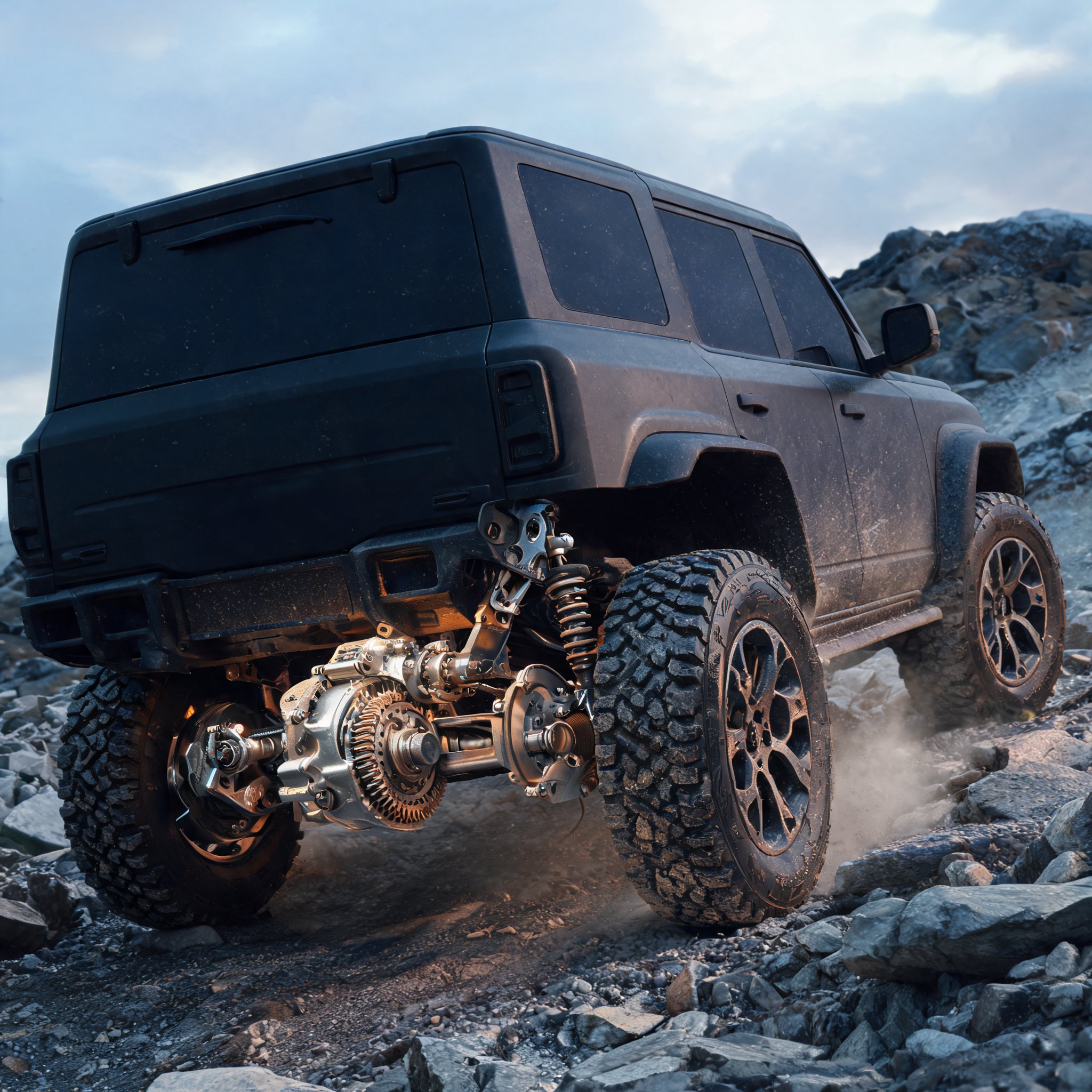
Portal axles are prized by hardcore off-roaders because they lift a vehicle’s drivetrain hardware above the obstacles instead of leaving it hanging below the frame. They use a stack of gears behind each driven wheel to raise the axle shafts and keep hardware above the frame line. They are also notoriously expensive. Zeph Gage’s rear-only conversion for an XJ Jeep takes a different route, using a flipped differential, Humvee geared hubs and custom fabrication to deliver much of the benefit at a fraction of the usual cost.
A low-pinion housing turned upside down
A typical set of portal axles from companies such as 74Weld costs about $20,000. Gage’s setup costs roughly one-fifth of that. It combines a Ford 9-inch axle housing, geared hubs from a Humvee and a set of Jesse Haines Fabrication HMMWV portal adapters.
The key problem is direction. Two-gear portals like the Humvee units take the input shaft’s rotation and reverse it. To make that work with the Ford 9-inch, Gage flipped the differential upside down so the driveline spins the correct way. A Yukon Gear and Axle third member is then bolted to the differential, turning low-pinion parts into what amounts to a budget high-pinion arrangement.
Clearance without sacrificing shock travel
The conversion adds about six inches of clearance. It is also credited with retaining full shock travel, a difficult goal with portal axles, and with reducing stress on the differential itself. The setup is intended to be effectively bulletproof as a result.
Why the front axle stays conventional
Installing a portal only at the rear may look unusual, but it is a common trick in the remote-control rock crawler scene. By keeping the solid front axle, Gage avoids the packaging constraints that often arise when portal axles are fitted to a vehicle that never had them from the factory. He also does not have to restrict shock travel to make the parts fit, and the ride height does not rise to an extreme level. The arrangement aims to capture the main clearance benefit while limiting the tradeoffs.
Custom parts and a practical result
This is not an off-the-shelf kit. Gage produced homemade brackets, custom-tapped plates and a two-piece brake rotor paired with a Ford Fusion caliper. The Fusion hardware was chosen partly because it offers an integrated electric emergency brake solenoid, and partly for clearance.
The finished XJ can drive over a five-gallon bucket and still have several inches of spare clearance. That means the rear end is less likely to hang up on obstacles that the front end can steer around. The build required extensive fabrication, but the result is a compact Jeep with a substantial clearance advantage at the rear.
More specifics, including how Gage matched the gearing front and rear, are covered in a video from Outdoor Auto.