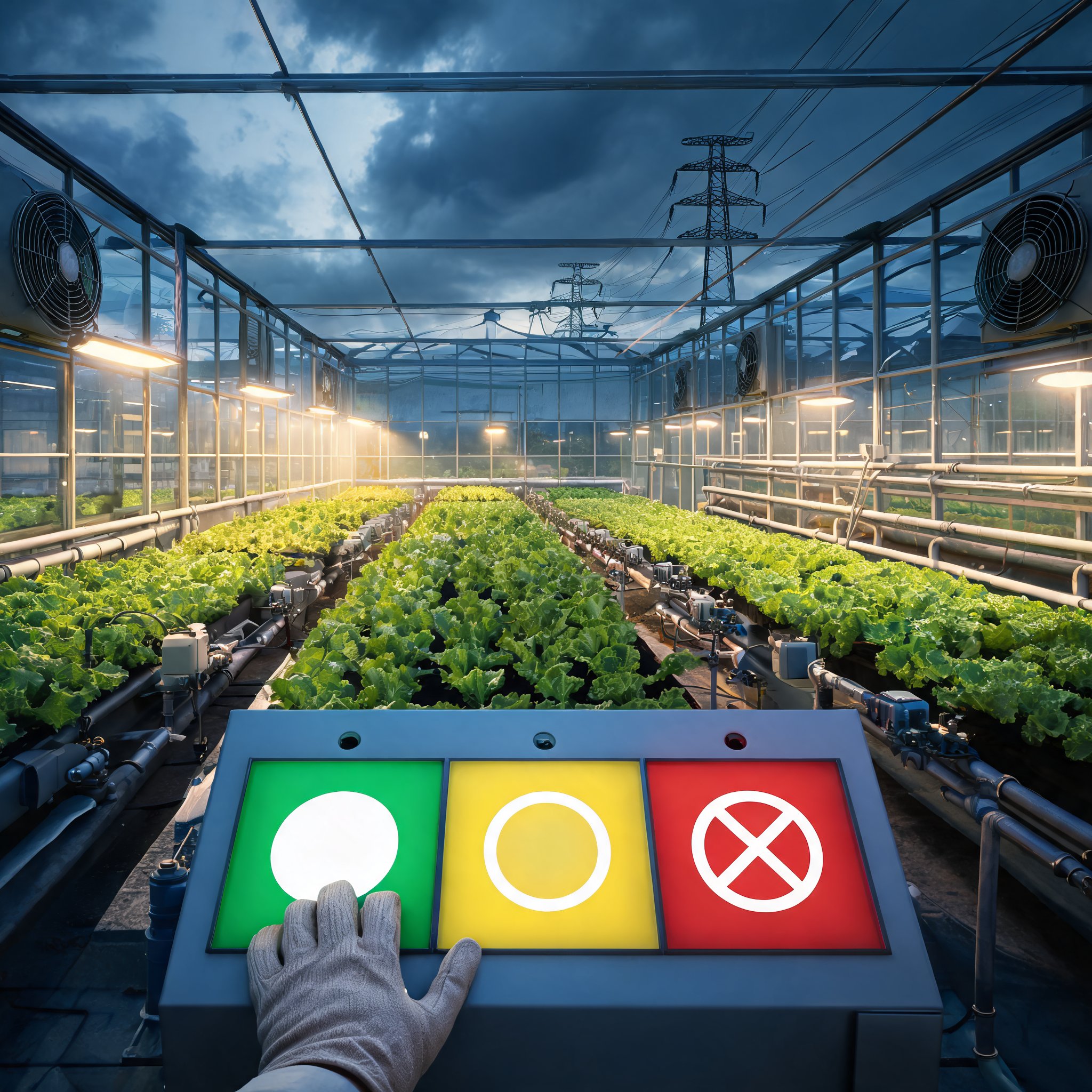
When a regional grid runs short of power, utilities follow emergency plans that can shut off electricity in blocks, sometimes with only minutes of warning. Hospitals and other critical facilities are protected where possible. Most other customers, including commercial greenhouses, are not. A greenhouse can lose fans, pumps, irrigation, heating and environmental controls at the same time—precisely when a crop is most vulnerable.
Federal reliability standards, including NERC’s EOP-011, require grid operators nationwide to maintain plans for cutting load. California draws unusual attention to the issue because utility bills print a customer’s rotating outage group or block, showing where the site falls in line. Even where that number is not printed, every grower has a place in the sequence.
An outage is not the same as a curtailment
Rolling outages have affected several regions in recent years during heat waves and winter storms. For a greenhouse, the risk is not only lost power but simultaneous loss of the systems that manage temperature, humidity, irrigation and light. Utilities plan for that day in detail. Most greenhouses do not.
The difference between an outage and a curtailment is control. In an outage, everything stops at once. In a planned curtailment, the grower decides in advance which loads drop, by how much and which remain on to protect the crop. The plan is a written playbook for the hours when the grid is under stress.
Four steps to a workable plan
- Inventory the load. List major equipment and estimate how much power each item draws: supplemental lighting, fans, evaporative cooling, heating, pumps, dehumidification, controls and cold storage.
- Sort by crop risk. Some loads can be dropped entirely for a few hours without harm. Some can be reduced by dimming lights, staggering fans or moving a setpoint a few degrees. Controls, alarms and whatever keeps the most sensitive crop alive must stay on. The ranking depends on the crop and its stage, so it can change through the season.
- Use forecasts as a trigger. An outage order may arrive with minutes of notice, but heat waves and cold snaps are forecast days ahead, and grid operators usually issue public alerts before an emergency. In summer, growers with a plan pre-cool in the morning, irrigate early and close shade curtains before the afternoon peak. In winter, they heat ahead of the cold peak, close thermal curtains early and confirm backup heat is fueled and tested.
- Assign decisions and test automation. Decide who receives the alert, who makes the call and who carries it out. If the environmental controller can run the sequence automatically, program it and test it. A plan that depends on one person answering a phone on a Saturday afternoon is not a plan.
From crop protection to demand response
After those steps, a grower should know how many kilowatts the site can give up, for how long and at what cost to the crop. That number is what the grid is willing to pay for. Before ordering outages, utilities and grid operators will pay customers that agree in advance to cut load, because a megawatt that disappears on request is cheaper than one bought at emergency prices. The market is demand response, and it exists in most of the country, largely so the outage plan never has to be used.
Growers can ask their utility where the site falls in its emergency plan. They should also start making their own plan—one that protects the crop when the grid cannot.