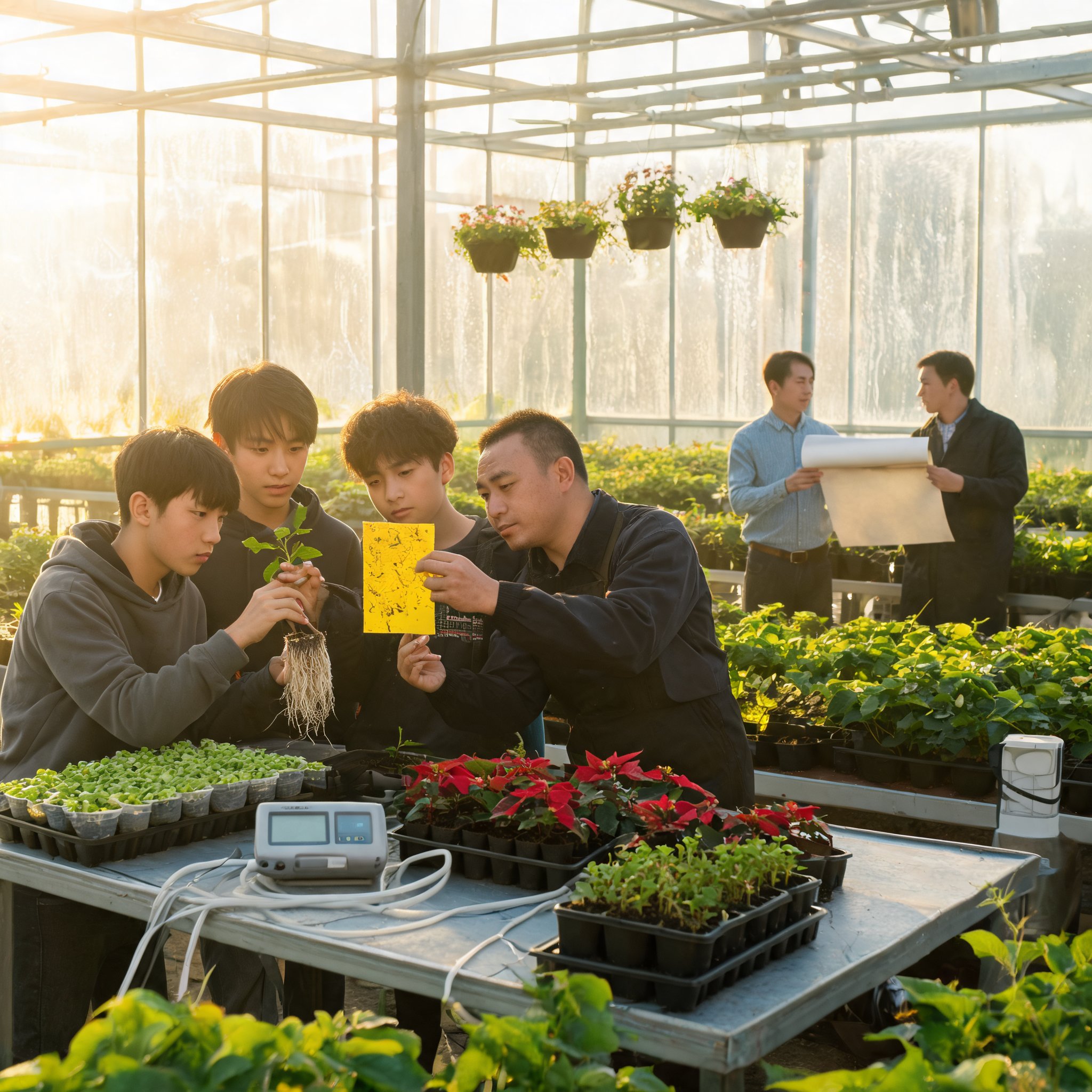
Jeff Neese, a Biological Solutions Advisor for BioWorks with more than 35 years in commercial horticulture and integrated pest management, argues that the greenhouse industry begins its workforce conversation too late. The difficulty of finding growers with practical production experience is usually discussed through succession planning, college recruiting and competition for a limited talent pool. His question is earlier: where are young people supposed to discover horticulture in the first place?
Neese's answer comes from his own path. At Warren Central High School in Indianapolis, he walked into a warm, humid, green greenhouse during an Indiana winter. He had vocational horticulture and two teachers, Phil Pitts and Pam Greene, who showed him that horticulture could be a career, not only an interest. Pitts brought experience as a grower and landscape designer and set high expectations; Greene taught floriculture. Their classes were not about memorizing plant names or filling out worksheets. Students were expected to understand plants and learn to grow them well. Plants still needed water on weekends; insects and diseases did not wait for Monday; crops responded to light, temperature, water and nutrition whether school was in session or not.
That experience gave Neese enough knowledge, experience and confidence to skip college and enter horticulture directly. More than 40 years later, he is still in the industry. He does not diminish college: the industry needs university-trained horticulturists, plant scientists, breeders, researchers and growers. But college should not be the first place a young person discovers horticulture, he argues, and a four-year degree should not be the only respected route into a professional growing career. The pipeline problem begins before hiring: too few students get early exposure, technical support and a visible path.
The school greenhouse is not enough by itself
Neese supports high-school vocational horticulture, but warns that a greenhouse behind a school is not a solution on its own. A greenhouse is a living laboratory, and operating one requires knowledge, commitment and time. Agriculture teachers may cover broad subjects; expecting each to be an accomplished greenhouse grower, crop scheduler, irrigation specialist, diagnostician, IPM practitioner and environmental-control expert is unrealistic. Nor should teachers develop those skills alone.
His proposal is for commercial growers to become active partners in local school programs, not to take over the greenhouse or dictate curriculum but to serve as a technical resource. Growers could help develop an achievable crop plan and realistic standards for irrigation, fertility, pH, EC, temperature and crop timing. They could walk the greenhouse with students and teach scouting rather than simply identify a problem. They could show how sticky cards are used, how roots are examined, how nutritional problems are diagnosed, and how growers think through decisions. They could help teachers use existing equipment and give them someone knowledgeable to call when something goes wrong.
That matters because practical growing knowledge is concentrated inside commercial operations. Neese argues that if the industry is serious about workforce development, some of that knowledge needs to reach the classroom. Not every instructor needs to be another Phil Pitts or Pam Greene. Teachers need industry expertise, encouragement and support around them so students can experience horticulture meaningfully.
Summer internships show one snapshot
Neese also challenges the assumption that summer internships are sufficient. For most high-school students, summer is the only extended period for full-time work, but it can give a narrow view. Much of spring's diversity may be over. It is hot and humid. Inexperienced seasonal employees can end up doing whatever job nobody else wants: sticking poinsettias, spacing crops, moving plants or cleaning houses.
Those tasks are not inherently wrong, he writes. They are part of commercial horticulture, and every good grower should understand the physical work behind a crop. The problem is when that is the whole experience. A teenager may experience greenhouse labor without experiencing greenhouse management. To understand growing, students need to see how production changes through the year: fall crops and shortening days; winter's lower light and humidity; spring propagation and peak production; summer heat, irrigation demands and preparation for the next cycle. An eight-week internship gives one snapshot, Neese says; learning horticulture requires seeing the whole movie.
His alternative is to make the school greenhouse and the commercial greenhouse extensions of one another. If a participating grower knows what students learned in class, the summer job becomes the next chapter rather than an unrelated break. Students who studied pH and EC could see how those are monitored commercially. Those who learned scouting and IPM could join a crop walk with the person responsible. Those who studied irrigation and fertility could see injectors, water systems and fertilizer programs.
Even repetitive work becomes more meaningful when the decisions behind it are explained. A student sticking a poinsettia cutting could learn where it fits in the production schedule, what happens during rooting, when the crop will be transplanted, what the grower watches for and why the finished-crop date matters. The work is not eliminated; it becomes learning. Neese extends the logic across the school year: growers visiting classrooms, helping with crop planning, troubleshooting the school greenhouse and inviting classes into commercial operations at different points in the cycle. By summer, students begin to understand why the work is being done.
A recruiting relationship, and a second path
That partnership also creates a recruiting opportunity. A student might first meet a company as a sophomore taking horticulture classes, visit the greenhouse or work with a grower as a junior, and spend the summer with the team. In the senior year, the student could keep developing skills at school while maintaining the relationship. At graduation, the path into horticulture should already be visible.
Neese writes from experience in developing people. Some of the most rewarding growers he has worked with were people he helped develop. They did not arrive knowing everything; they learned crops and operations from the ground up, took on greater responsibility and gained confidence because someone invested time in teaching them. That is more than recruiting, he argues; it is developing a horticulturist before high school ends.
College remains the right next step for many students, and Neese says it should be encouraged when it is. But for students who cannot attend, do not want to attend or, like him, know they want to start working, there should be another respected path. An 18-year-old with several years of vocational horticulture, commercial exposure and mentorship from experienced growers should not be treated simply as unskilled labor. That person is a young horticulturist at the beginning of a career. Give them responsibility, continue teaching them and show where the career can lead.
Neese does not claim schools or growers can solve the problem alone. He sees an opportunity between those worlds. Instead of only attending career fairs, posting openings and wondering why applicants lack practical experience, growers could get involved earlier: find the local agricultural education or horticulture program, meet the teacher, walk through the school greenhouse, ask what is needed and offer knowledge rather than only old equipment and leftover plants. Students could be invited into operations in February as well as June, allowed to scout, test EC, examine roots, see good and problem crops, make mistakes and understand the decisions behind a quality crop. Summer work should give them a reason to want the grower's job someday.
The closing image is another teenager walking into a greenhouse for the first time. That student could become an exceptional grower, IPM specialist, propagator, production manager or greenhouse owner. Pitts and Greene opened that door for Neese, and horticulture became not a fallback but the opportunity. More than four decades later, he says, part of what they taught him still walks into every greenhouse with him. If the industry is concerned about the next generation, it should stop waiting for someone else to produce it. The future may already be sitting in a high-school classroom; the task is to help it grow.